
ephemera of becoming
grief is a living notebook

‘Why did I write it down?’ Joan Didion asks. ‘In order to remember, of course, but exactly what was it I wanted to remember? How much of it actually happened? Did any of it? Why do I keep a notebook at all?’
*
Grief is changing the way I process information/
A paragraph is an empty field. I can only make sense of fragments and paratext/
Peripheral material around and between experience. Ghostly versions of the truth/
Grief is the sometimes slippery, sometimes sticky, narrative that forces its way through. The rupturing of everything that once held meaning. A world doubling violently/
How to sustain a line of thought, much less a line of verse. Next to grief, everything else is dull, wooden, unfeeling/
Grief peels back my layers and leaves something raw and ghastly in its wake. It’s jarring – an outpour into the public realm. My grief-body feels grotesque. A monster/
People keep asking if I’m ok/
//I’m not//
People keep asking if I’m ok because the monster keeps getting out/
Grief is a living thing that contorts and shapeshifts. Grief trembles underneath. Grief rivers on top. The grief-body becomes the only body.
The feeling of not being ok eventually becomes the new way of being ok/
*
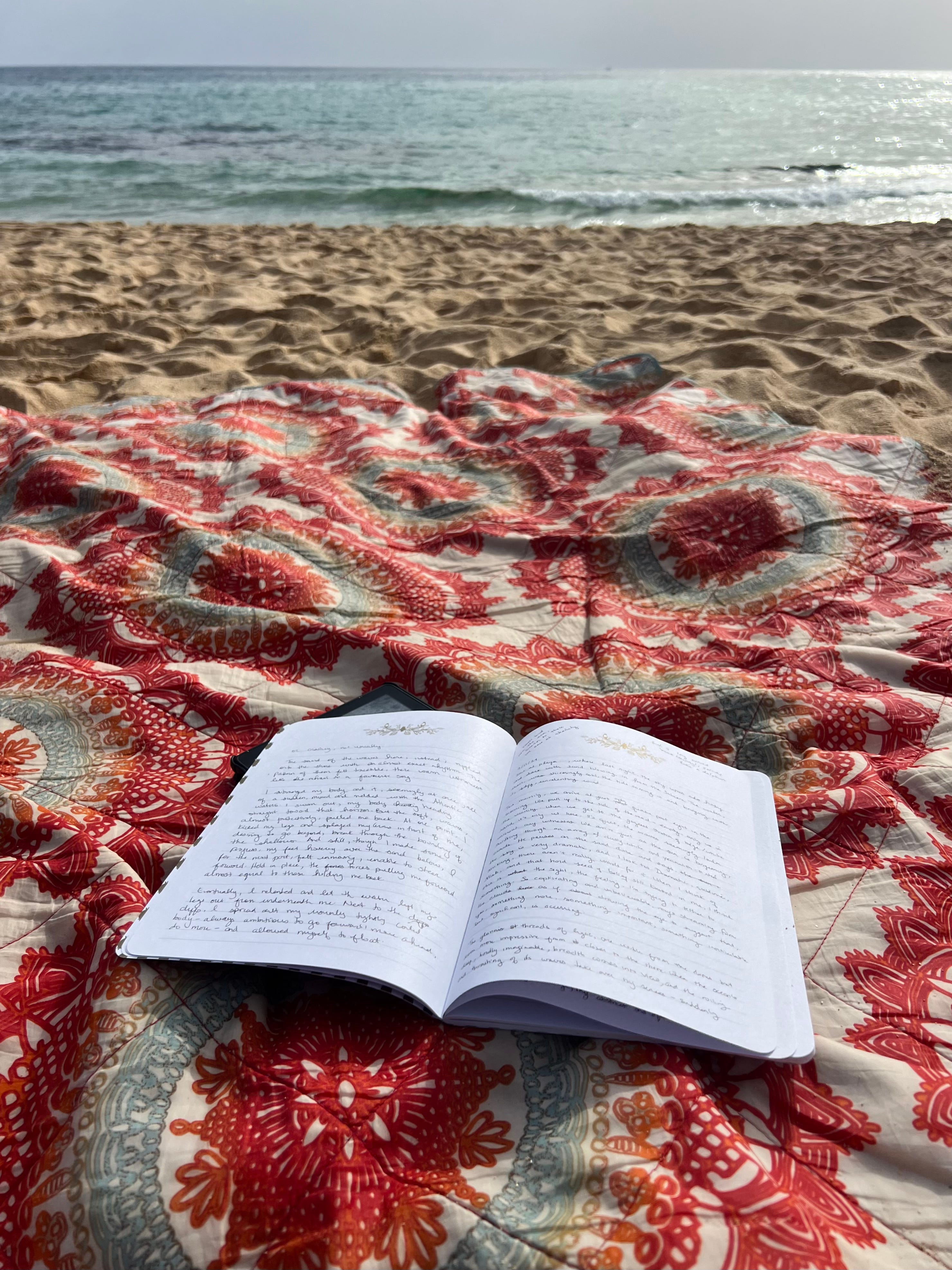
Lately, I’m reading a lot about notebooks and diaries. Ephemera of becoming. Discursive, nonlinear, fragmented, experimental – confessional.
Grief is a living diary with pages missing. I derive meaning differently now. I find it hard to express myself, sentences slicing midway through. Ending abruptly. Articulation never feels like enough.
I’m relearning the way I want to be known by the world and the way I need to move through it.
*
What is important enough, or significant enough, to write down?
I’m navigating the confusing gap of wanting everyone and no one to know about my grief. I feel compelled to let it spill into visible-readable words, where it seeks out both public and private spaces. I don’t want to craft my grief. But it slithers through into everything, as is, and metaphor is one way to guide it.
Still, my sadnesses feel small. My fragments repetitive. My grief amorphous and uninteresting.
This is all acceptable in a recursive diary, maybe, but not here, in the performative and manufactured artificiality of the world.
*
*
Grief is changing my body too. It curls into itself. It wants to be small, invisible, non-existent.
After the funeral, I returned to Edinburgh – home, I guess, though it didn’t feel like it. Doesn’t feel like it. Home felt/feels like the place where he is buried. The place where my language pluralises.
Home is back there, in Edmonton, in the past, where and when he was alive. Home is a different body that stretched far and wide across oceans. A growing repetition rather than a desire to disappear.
Home is the past-body: the body before the grief-body was jolted awake.
Meanwhile, Edinburgh is the home in which I currently have an ‘indefinite leave to remain’ application pending. The home that will assess my right to residency based on paperwork and immigration laws. The ‘home’ that I grow nervous might reject me for signing letters and organising in solidarity with Palestine, for protesting settler-occupation and genocide.
Edinburgh halves my heart into a thing with borders.
Edinburgh is the home he never saw.
*
I was writing before I knew the anatomy of a line, of a poem, of a paragraph.
Now for the most part, writing escapes me. I’ve been writing this particular notebook-newsletter for weeks. Each word is a slow trawl across the page. I keep thinking, ‘so what’ and ‘who cares.’ I keep thinking ‘not the word grief again.’
Grief has changed writing, how it feels to write, too.
I have been thinking about how grief is a horrible revelation. How it is, if not exactly permission to transgress, the inescapable and total disregard for what I once thought of as ‘normal’ behaviour.
Grief is not palatable or professional. Grief is a neon sincerity that almost burns the eyes to look at.
I’m treating all my internet spaces, all my real life conversations – everything – like a notebook or a diary. It’s embarrassing but I can’t stop.
*
The way we speak about craft, or crafting, doesn’t always account for multiplicity or hybridity. We are often crafting according to guidelines set for us by institutions and academic programmes. What is important enough to write down? And who gets to decide?
What do we remember – collectively? And who crafted our historical memory?
The better we get at crafting, the better we get at creating objects.
But the diary feels subversive. An entry reaches out like an outstretched hand, wanting connection to something real.
The diary/notebook as necessary, as the only option. The means of processing peripheral material, those backtracking versions of the truth.
*
Grief has changed everything. And it has changed everything without my permission. Without my willingness. It has changed how I empathise. It has changed how I relate to the world. I keep rethinking and reiterating this.
It has changed the way I care about things. What was once important is no longer important. Everything has a new and unruly edge. Everything is more error than perfection. Everything is messy, scratched out, spiralling, atemporal.
Everything is loosely entwined with the hope that a mere asterisk will hold it – me – together.
Notes
1. My ILR application was approved while writing this entry.
2. I have finished the edits on Shorelines, my debut nonfiction book. It’s incredible that already, the woman who wrote that book feels like an entirely different person to the woman who is writing this newsletter.
3. I’m so terrible at replying to messages and still have my out of office on. I’m so sorry. Sometimes I think I might be on compassionate leave forever.
There’s a raw wisdom here in the way grief is held not just as subject matter but as form. Fragmentation, recursion, slipping syntax, hesitation, all of it echoes the real-time collapse of what once felt familiar, both in language and in life. I was struck again and again by how honest it is to admit that writing feels impossible while still writing anyway. The slow trawl of words across a page, the shame of repetition, the haunting return of the same word (grief) until it becomes both too much and not enough. Lines like “grief is a neon sincerity that almost burns the eyes to look at” stopped me completely. Not just for their poetic sharpness, but for how they name what so many avoid: that grief is not gentle, or polite, or subtle. This essay is a reminder that sometimes, writing is not about creating something beautiful or complete. Sometimes it’s just the slow, aching act of keeping the thread alive. Sentence by sentence, slash by slash, asterisk by asterisk. And that’s more than enough. Thanks so much
After reading your post here, I wish I could rectify my reply to your note. There’s a lot more to your longing for deeper connection than ‘our age’. I send you my deepest and sincerest sympathies. 🌹